
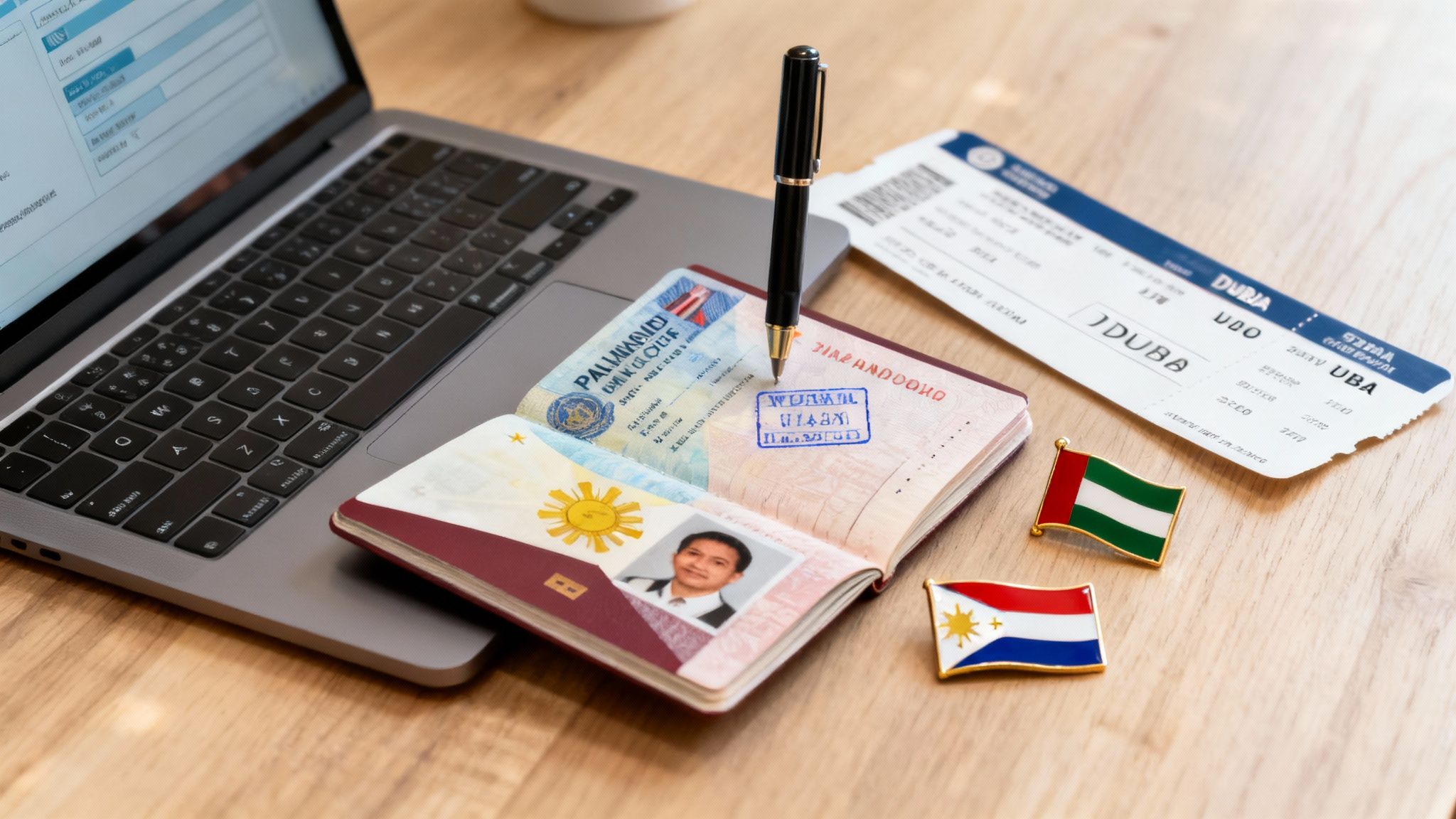
So, you're planning a trip to Dubai? That's fantastic. But first, let's talk about the visa. For anyone holding a Philippine passport, securing a visa before you fly is an absolute must. Unlike some destinations, you can't just get one on arrival in Dubai.
The good news is that the process is straightforward once you know the ropes. It all boils down to finding a sponsor—and no, that doesn't mean you need a personal connection. Your sponsor will be the airline you fly with, the hotel you book, or a licensed travel agency.
The connection between the Philippines and the UAE is incredibly strong. There are around 700,000 Filipinos living and working across the Emirates, with a massive 450,000 of them in Dubai alone. This huge community means the path for tourists, family visits, and workers is well-established. You can read more about this on the Wikipedia page for Filipinos in the United Arab Emirates.
Getting Started: The Application Essentials
Here’s the most important thing to understand: you won't be heading to the UAE embassy in Manila to apply directly. The entire process is handled through an accredited sponsor. It might sound a bit intimidating, but it's just how the system works, and it's actually quite efficient.
Your main options for a sponsor are:
- Airlines: If you're flying with a carrier like Emirates, they often have a built-in visa processing service you can use right after booking your ticket.
- Hotels: Many hotels in Dubai can sponsor your visa, provided you have a confirmed and paid reservation with them.
- Travel Agencies: This is often the go-to route. Countless accredited agencies specialize in Dubai visa applications and can walk you through every step.
For a deeper dive, this complete guide on how to apply for a UAE visa is an excellent resource that covers the A-to-Z of the process.
To give you a quick snapshot of what to expect, I've put together a table summarizing the most common visa types, their timelines, and what they might cost.
Dubai Visa Essentials for Filipino Applicants
This table gives you a quick summary of the key details for different Dubai visa options available to Philippine passport holders.
| Visa Type | Typical Validity | Processing Time | Estimated Cost (PHP) |
|---|---|---|---|
| 30-Day Tourist Visa | 60 days to enter, 30-day stay | 3-5 working days | PHP 6,000 – 8,000 |
| 60-Day Tourist Visa | 60 days to enter, 60-day stay | 3-5 working days | PHP 10,000 – 12,000 |
| 96-Hour Transit Visa | 14 days to enter, 96-hour stay | 1-3 working days | PHP 3,000 – 5,000 |
These figures are just estimates, of course, and can vary depending on the sponsor you choose and any extra services they offer.
My Key Advice: The sponsor is everything. Your choice between using an airline, your hotel, or a travel agency really comes down to your own travel style. Do you want the convenience of bundling it with your flight, or would you prefer the hands-on support of a dedicated travel agent? Think about what works best for you.
With this foundation, you're in a great position to move forward, choose the right visa, and start gathering your documents for a hassle-free application.
Choosing the Right Dubai Visa for Your Trip
Nailing down the correct visa for Dubai from Philippines passport holders is the most critical first step you'll take. The right choice hinges entirely on your travel plans: how long you’re staying, your reason for visiting, and if you plan on ducking in and out of the UAE. Getting this right from the get-go saves you from headaches, unexpected costs, and frustrating delays.
For most people planning a holiday, the short-term tourist visa is the go-to option. But even within that category, there are a few important distinctions you need to get your head around.
Short-Term Versus Long-Term Stays
For the vast majority of Filipino tourists, it boils down to two main choices: a 30-day visa or a 90-day visa. Your itinerary should be the deciding factor here.
A 30-day single-entry visa is your best bet for a standard vacation. If you're planning a one-to-three-week trip to see the sights, visit family, or hit the malls, this visa has you covered. It's the most cost-effective option and more than enough for what most tourists need.
If you need more breathing room, the 90-day long-term visa is the way to go. This is a better fit if you're planning an extended stay with family, want to discreetly explore job opportunities, or just prefer to travel at a leisurely pace without constantly clocking your visa’s expiration date.
My biggest piece of advice is to match your visa duration to your travel dates as closely as possible. Extensions can be a hassle, involving extra fees and paperwork. It's always easier and cheaper to get the right visa from the start.
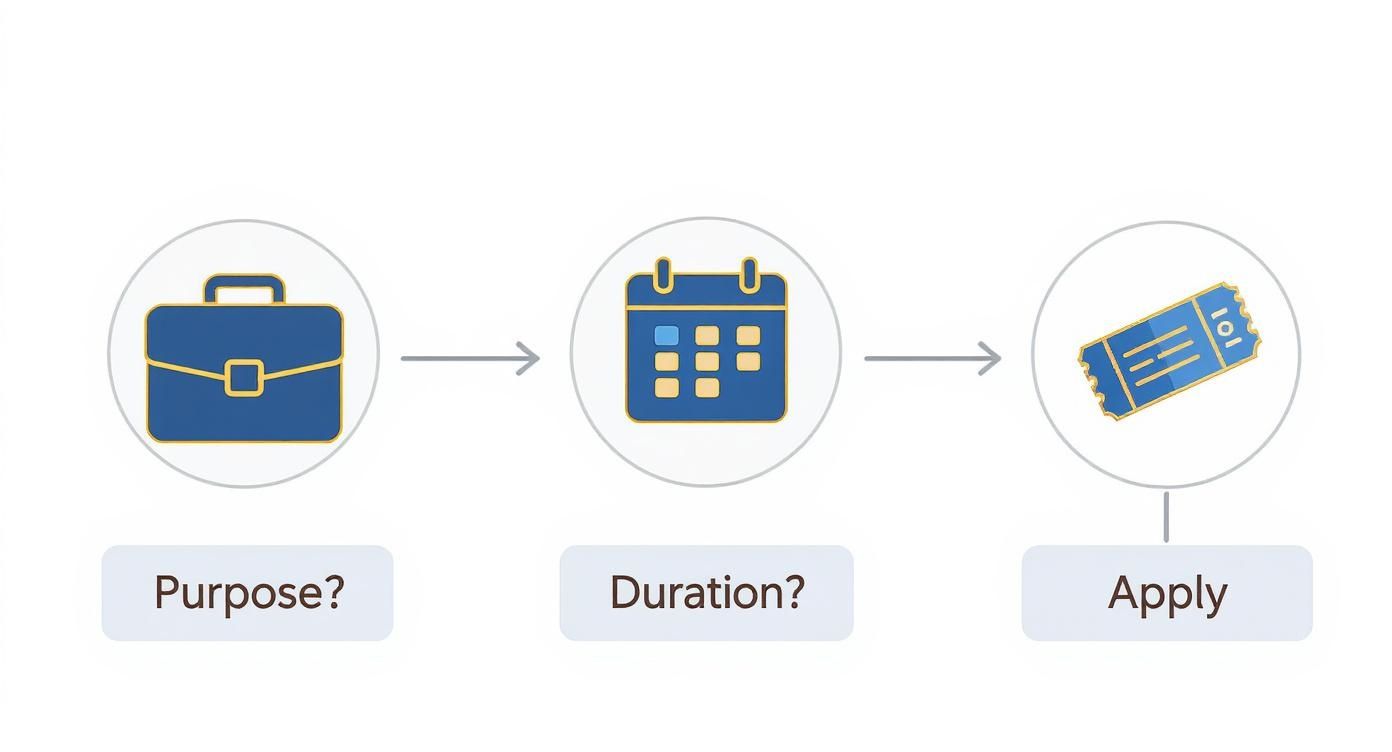
The process might seem complicated, but it's really about answering a couple of key questions about your trip's purpose and length before you even start filling out forms.
Single Entry or Multiple Entry Visas
Beyond just the length of your stay, you'll need to decide between a single-entry and a multiple-entry visa. This is absolutely crucial if your travel plans involve hopping over to a neighboring country.
- Single-Entry Visa: Think of this as a one-time pass. Once you enter the UAE and leave—even for a quick trip to Oman—your visa is used up. You can't re-enter on it.
- Multiple-Entry Visa: This gives you the freedom to come and go as you please within the visa's validity period. It’s perfect for travelers planning side trips or those on a cruise with multiple stops in Dubai.
Let's say you fly into Dubai, plan a weekend getaway to Muscat, and then need to return to Dubai for your flight home. In that scenario, a multiple-entry visa is non-negotiable. Choosing a single-entry visa would leave you stranded, trying to apply for a new visa from another country—a nightmare you want to avoid. If you're looking for ideas on trip timing, our guide on the best time to visit Dubai has some great insights.
Special Visa Categories to Consider
While tourist visas cover most travelers, there are a couple of other types worth knowing about, especially for Filipinos in specific situations.
A Visit Visa is different from a tourist visa. It’s typically sponsored by a close family member (like a spouse, parent, or child) who is already a UAE resident. The application process is a bit different because your sponsor is an individual, not a hotel or airline.
Then there's the Transit Visa, designed for people with long layovers. If you have a stopover in Dubai that's between 8 and 96 hours, you can get this short-term visa to leave the airport and see a bit of the city. It’s a great way to break up a long journey and turn a boring wait into a mini-adventure. Matching your visa to your real-world plans is the secret to a smooth application.
Preparing Your Visa Application Documents
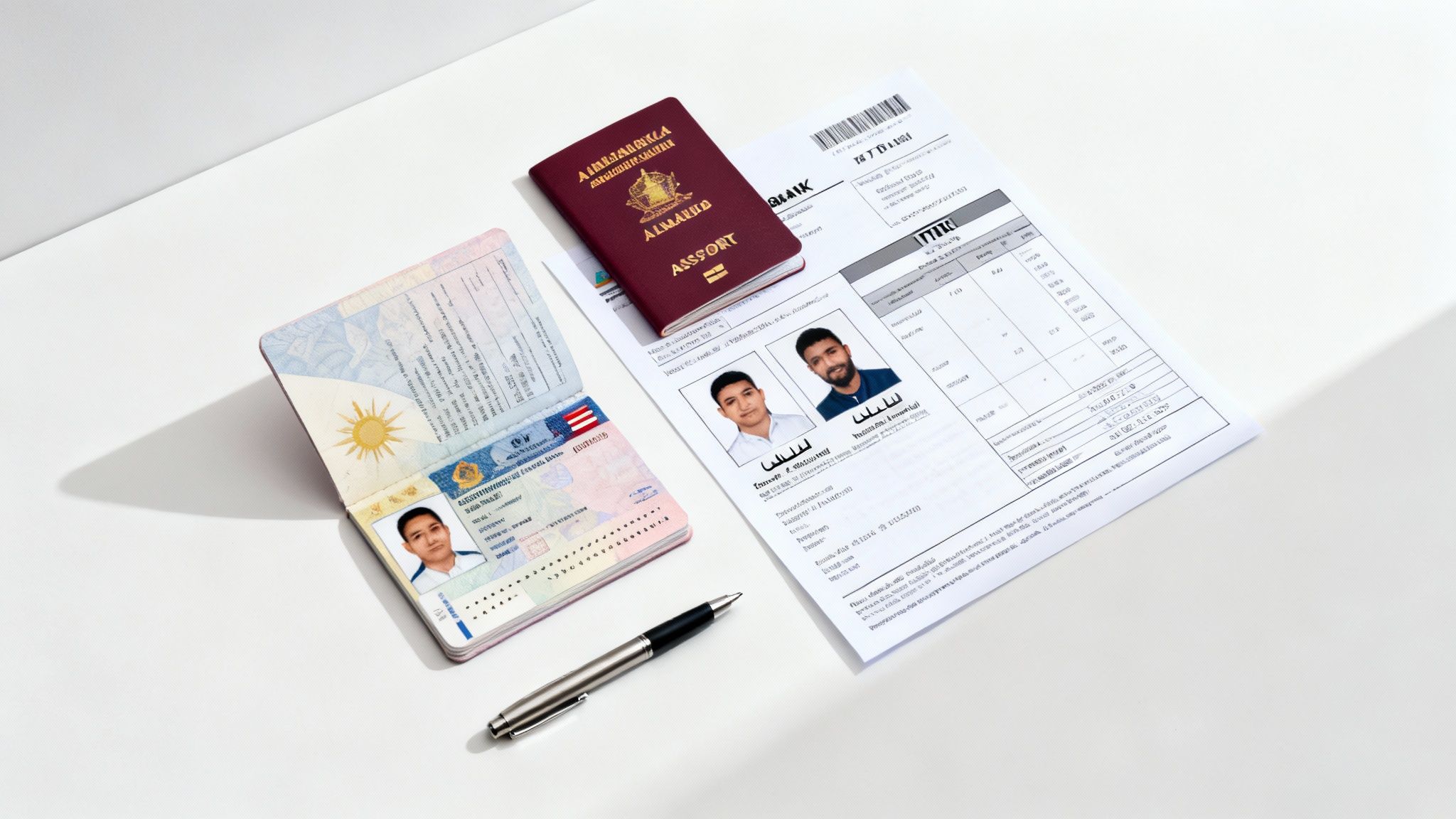
Getting your documents in order is the most critical part of the entire process. This is where your application lives or dies. Don't think of it as just ticking boxes on a list; you're building a solid case for why you should be granted entry. Every piece of paper tells a part of your story, and the goal is to make that story crystal clear.
The foundation of your application for a visa for Dubai from Philippines passport holders is built on a few non-negotiable items. Nail these basics, and you're already halfway there.
The Essential Core Documents
Your passport is, obviously, the star of the show. It absolutely must have at least six months of validity from the day you plan to land in Dubai. This is a hard-and-fast rule. A passport expiring in five months and 29 days is a guaranteed rejection, no questions asked.
Just as important is the quality of your passport copy. You'll need a clean, high-resolution color scan of the bio-data page (the one with your photo). I can't say this enough: a blurry, dark, or cropped scan is one of the most common—and easily avoidable—reasons for applications to get delayed or denied.
Takeaway Tip: Lay your passport flat on a scanner and make sure there's no glare from overhead lights. Before you upload that file, zoom in and check that every single letter and number is perfectly readable.
Next up, your photos. The UAE has very specific requirements, and they aren't flexible.
- Size & Background: They must be standard passport size (usually 2×2 inches or 45×35 mm) against a pure white background. No cream, off-white, or light gray.
- Quality: The photo needs to be recent (taken in the last six months), in color, and high resolution.
- Your Appearance: Look straight at the camera with a neutral expression. No smiling. If you wear glasses, make sure there’s no glare. Head coverings are only allowed for religious reasons, and they can't obscure your face.
The Dubai Visa Document Checklist for Philippine Citizens
Gathering all the right paperwork can feel overwhelming, but breaking it down makes it manageable. I've put together this checklist based on years of experience to help you organize everything needed for a standard tourist visa application.
| Document Category | Specific Requirement | Expert Tip |
|---|---|---|
| Personal Identification | Passport with 6+ months validity from entry date. | Double-check your expiry date before you even start the application. This is the first thing they look at. |
| Identification Photo | Recent, passport-sized photo on a pure white background. | Don't use a selfie or a cropped photo from social media. Go to a professional studio; it's worth the small cost. |
| Financial Proof | Income Tax Return (ITR) and/or recent bank statements. | A consistent balance over 3-6 months is much better than a large, sudden deposit. They're looking for stability. |
| Employment Status | Certificate of Employment (COE) or a No Objection Certificate (NOC). | An NOC from your employer stating your leave dates is more powerful than a standard COE. It shows clear approval for your trip. |
| Flight & Hotel | Confirmed round-trip flight booking and hotel reservation. | You don't need to pay for the flight yet. A confirmed booking itinerary is usually sufficient for the initial application. |
| Travel Insurance | United Arab Emirates Travel Health Insurance is highly recommended. | While not always a mandatory upload, authorities can ask for it. It's better to have it and not need it, than to need it and not have it. |
Remember, the goal of this collection of documents is to present a complete and trustworthy picture of you as a legitimate tourist.
Demonstrating Your Financial Capacity
This part makes a lot of people nervous, but it's really just about proving you can afford your trip and have strong reasons to return to the Philippines.
An Income Tax Return (ITR) is a powerful document because it signals a stable job and financial ties back home. If you're submitting bank statements, what matters is consistency. A statement showing a healthy, steady balance looks far more credible than one with a sudden, large deposit right before you apply.
For Filipinos, there are sometimes specific financial benchmarks that can really strengthen an application. Having an ITR that shows a gross annual income over PHP 200,000 for the last two years, or fixed deposits of PHP 500,000 or more, can make a significant difference.
Supporting Documents That Seal the Deal
Beyond the essentials, a couple of other documents can really bolster your case. If you're employed, a Certificate of Employment (COE) is a must. It should be on company letterhead and clearly state your job title, salary, and start date.
Even better? A "No Objection Certificate" (NOC) from your employer that explicitly confirms they approve your travel dates. This simple letter removes any doubt that you have a job waiting for you when you get back.
Let's see how this works in a real-world scenario. Picture a young professional applying for her first trip to Dubai:
- Her Passport: Valid for another three years. She gets a high-res color scan of the main page.
- Her Photo: She goes to a photo studio and gets a proper passport photo on a white background.
- Financial Proof: She provides her ITR from last year showing a PHP 350,000 salary and a bank certificate reflecting a consistent balance of around PHP 90,000 for the past six months.
- Employment Proof: She asks HR for an NOC confirming her approved vacation leave.
This combination of documents paints a clear, compelling picture: she is a responsible tourist with a stable career and the funds to enjoy her trip. That’s the kind of application that gets a swift approval.
Deciding Where to Apply: Airlines vs. Travel Agencies
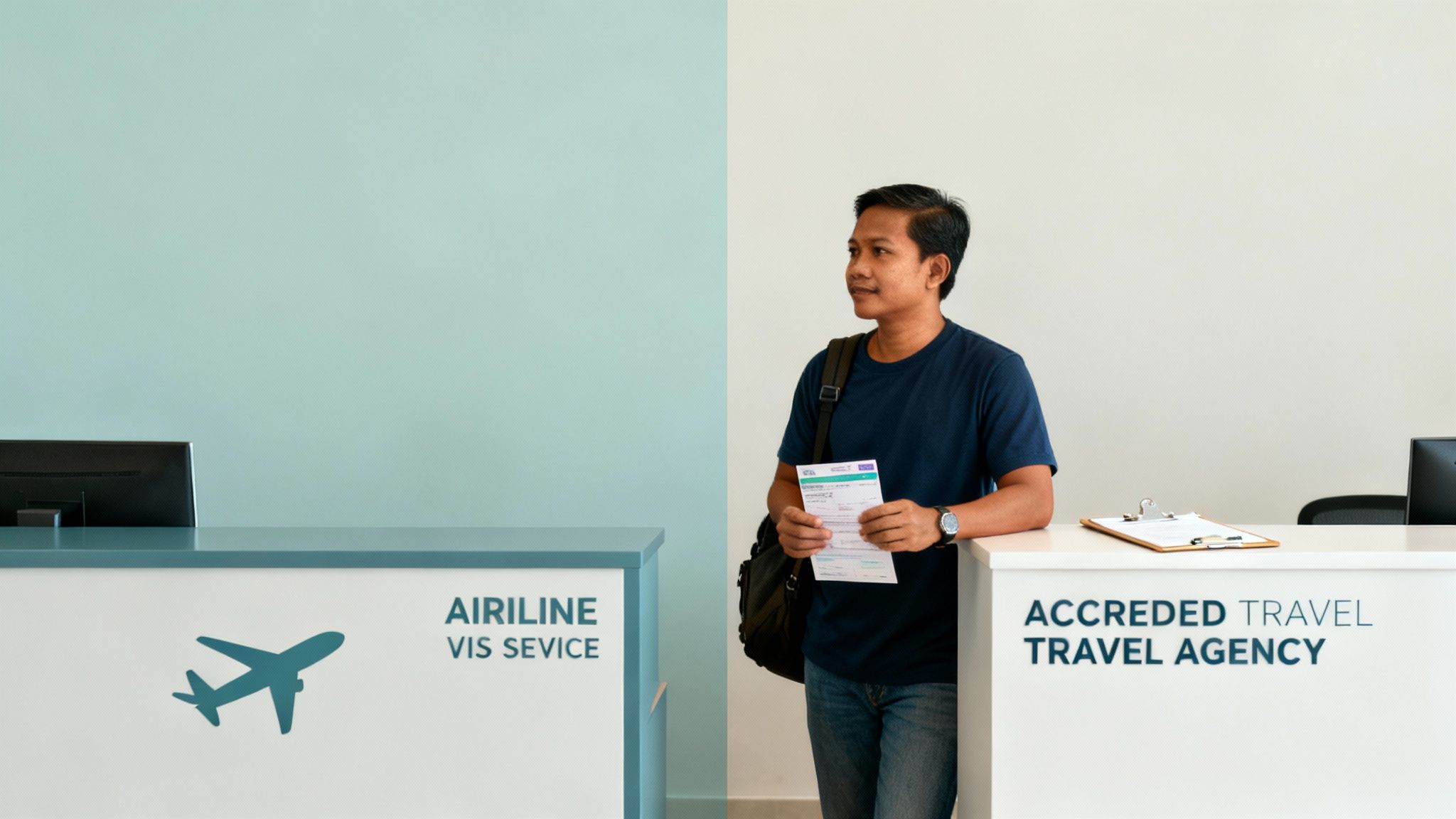
Since you can't just walk into a UAE embassy in the Philippines to get a tourist visa, you have to go through a sponsor. This is where your first major decision comes in: should you apply through an airline or a travel agency?
This isn't just about who processes the paperwork. Your choice here impacts the cost, the amount of hand-holding you get, and how smoothly everything goes. Let's break down the pros and cons of each path so you can figure out which one makes the most sense for you.
The Airline Route: Fast and Integrated
Applying directly through UAE carriers like Emirates or Etihad is often the most straightforward option. Once you've booked your ticket, you can usually start your visa application right from their website's "Manage My Booking" section. It's a neat, all-in-one package.
This path is perfect for the seasoned traveler. If your documents are flawless, your travel history is solid, and your trip is straightforward, the airline's system is incredibly efficient. They are sponsoring you as their passenger, which cuts out a middleman.
But that convenience has its trade-offs.
- Minimal Support: Airline visa services are very transactional. You upload your documents into a portal, and that’s pretty much it. If something's wrong, you might just get an automated rejection email with no clear explanation, leaving you to guess what went wrong.
- No Flexibility: This service is locked to your flight booking. You can't use it if you're still comparing flight prices or if your travel dates aren't set in stone.
- One-Size-Fits-All Process: Airlines are built for volume, not nuance. Their systems aren't designed to handle unique situations, like a first-time international traveler or someone with a less-than-standard employment record.
The bottom line: For a confident traveler with perfect paperwork, the airline channel is a fast, no-frills way to get your visa. It’s seamlessly integrated with your flight, making it feel like part of the booking process.
The Travel Agency Route: The Personal Touch
Going with an accredited travel agency offers a completely different experience—it's far more personal and hands-on. Think of them as your guide through the entire maze of Dubai visa requirements. This is a game-changer, especially if it's your first time applying or if you're feeling overwhelmed by the process.
A good agent's value isn't just in submitting the forms. Their real work happens before submission. They'll scrutinize every document, catching things you might miss—like a passport photo that's slightly out of focus or a bank statement that doesn't quite tell the right story. This pre-check alone can be the difference between approval and rejection.
Imagine this scenario: a Filipino freelancer with inconsistent monthly income wants to visit Dubai. An airline's automated system might flag their financial documents as insufficient. A savvy agent, on the other hand, knows how to build a stronger case. They might advise including recent project contracts or a letter explaining their work to paint a clearer picture of financial stability.
Key advantages of using a travel agency:
- Expert Guidance: They live and breathe this stuff. They know the latest rule changes and can give you advice tailored to your specific circumstances.
- Document Vetting: A human set of eyes checks your papers for common mistakes before they're submitted. This is huge.
- Support for Complex Cases: They're experienced in handling applications that don't fit the typical mold.
- Peace of Mind: Handing the process over to an expert can take a massive weight off your shoulders.
Of course, this expertise isn't free. Agencies charge a service fee on top of the visa cost, making it the more expensive option. You have to weigh that extra cost against the assurance and expert support you're getting. For many Filipinos, especially those new to international travel, that peace of mind is well worth the price.
What to Expect: Timelines, Costs, and Final Steps
Alright, you’ve submitted your documents. Now comes the part that requires a bit of patience: waiting for the approval. Getting a handle on the typical processing times and costs for a visa for Dubai from the Philippines is key to keeping your travel plans (and your budget) on track. This final stretch is all about knowing the timelines and being ready for a smooth arrival.
The processing period can feel like a black box, but it’s actually quite predictable. You can generally expect your e-visa to be processed within 5 to 6 working days. Just remember, the UAE’s work week is different, so this doesn't include their weekend (Saturday and Sunday) or any public holidays.
Decoding Processing Times
While that 5-6 day window is a solid benchmark, things can shift. If you apply during a peak travel season or right before a major holiday, you might see a slight delay as the system handles a higher volume of applications. This is precisely why getting your application in early is always the best move.
Need it faster? Most airlines and agencies offer an express service for an extra fee, promising a turnaround in just 1-3 working days. But is it worth the added cost?
- When to consider express service: It’s a lifesaver for an urgent, last-minute trip. It’s also a great option if you just want the peace of mind that comes with a quick approval.
- When to stick with standard service: If you're planning your trip at least three or four weeks out, the standard processing time is perfectly fine and will save you some cash.
The decision you make here directly affects your overall budget, which brings us to the next crucial piece of the puzzle.
A Transparent Look at Visa Costs
No one likes financial surprises, especially when planning a trip. The total visa cost isn't just one flat fee; it’s a combination of the base fee and the service charges from your sponsor, whether that’s an airline or a travel agency.
Here’s a general breakdown of the costs involved:
- Base Visa Fee: This is the official government fee, which changes based on the visa type you need (like a 30-day versus a 60-day visa).
- Service Charge: Your sponsor tacks on their own fee for handling your paperwork, verifying documents, and guiding you through the process. This is where you’ll see the biggest price variations.
- Optional Add-ons: Think express processing, bundled travel insurance, or other convenient extras.
All in, you can expect the total cost for a standard 30-day tourist visa to be somewhere between PHP 6,000 and PHP 8,000. If you're looking for other ways to balance your travel budget, you might find our guide on last-minute tips for scoring affordable international flights helpful.
The travel corridor between the Philippines and the UAE is only getting busier, with visa grants growing significantly. Data shows visa issuances have jumped from around 315 in previous years to over 1,671 during peak travel times, a clear sign of strengthening ties.
Key Insight: Before you pay a single peso, always ask your sponsor for a fully itemized cost breakdown. This ensures you know exactly where your money is going and helps you dodge any unexpected hidden fees.
Your E-Visa Has Arrived: What Now?
That email with your approved e-visa is the moment you've been waiting for! Once it hits your inbox, there are just a few simple but crucial things left to do to guarantee a hassle-free arrival at Dubai International Airport.
First, print a clear, color copy of your e-visa. Yes, you'll have it on your phone, but immigration officers will ask for the physical paper. Keep it with your passport in your carry-on so it’s easy to grab.
Next, for your own peace of mind, it’s a good idea to verify the visa's authenticity online through an official UAE government portal. This quick check confirms your visa is valid and properly logged in the immigration system.
Finally, when you get to the immigration counter in Dubai, you'll need to present just two things:
- Your passport (with at least six months of validity left).
- The printed copy of your e-visa.
The officer will scan your documents, possibly take an iris scan, and stamp your passport. That’s it! With these small preparations, you’ll walk through immigration confidently, ready to kick off your Dubai adventure.
Frequently Asked Questions About the Dubai Visa Process
It’s completely normal to have a few last-minute questions pop up as you finalize your Dubai visa application. Getting these details sorted out is the final step to ensuring you can travel with confidence.
Let's start with a big one: sponsorship. For Philippine passport holders, a sponsor is almost always required. You can't just walk into the embassy and apply for a tourist visa yourself. Your sponsor will be the one handling the application on your behalf, and this can be an airline like Emirates, a hotel where you have a confirmed booking, or a registered travel agency.
Why Do Dubai Visa Applications Get Rejected?
Knowing the common pitfalls can save you a lot of time and stress. From my experience, most rejections come down to simple, avoidable mistakes.
The most common culprits are:
- A blurry or unclear copy of your passport's bio page.
- Typos or incorrect information on the application form itself.
- Using an old, non-machine-readable passport.
- A history of overstaying a previous visa in the UAE.
Honestly, the best defense is a good offense. Meticulously double-check every single document before you hit "submit." Make sure everything is crystal clear and accurate. A classic mistake is the passport photo—it must have a pure white background, no exceptions.
Do I Need "Show Money" at Dubai Airport?
This question comes up a lot. Officially, there's no set amount of "show money" you're required to present upon arrival. However, the immigration officer has the final say and can ask for proof that you can fund your trip.
It's just smart practice to be prepared. I always recommend carrying a recent bank statement, a credit card, or a sensible amount of cash. It shows you're a genuine tourist and helps make your entry into the country as smooth as possible.
If you have more questions, our comprehensive Frequently Asked Questions page covers a ton of other travel-related topics.
Ready to explore Dubai's most iconic attractions? From desert safaris to the top of the Burj Khalifa, My Global Trips makes booking your dream activities simple and secure. Plan your unforgettable Dubai experiences today!


[…] having access to tailored information can be a huge help. For example, there's a specific Dubai visa guide for Philippine citizens that details requirements just for […]